Visit any seller’s community discussion forum within India and the same question pops up frequently: “Should I just list on Amazon and Flipkart, or do I actually need my own website?” The majority of sellers opt for marketplaces. Most of them, after a while, realize their choice has cost them the thing they are unable to immediately recover: their reputation.
As a team, Amazon and Flipkart control almost 70% of India’s eCommerce market. This is a huge advantage, but it conceals an issue that many Indian enterprises are only starting to realize. The simplicity of registering on an online marketplace has resulted in many companies feeling more comfortable, and perhaps even too comfortable and a system that in the end serves the platform better than it does sellers.
The Convenience Trap That Holds Indian Sellers Back
Marketplaces provide something truly valuable with an established customer base, integrated logistics, and a dependable checkout experience. When a seller is new and has zero digital footprint, this could be a good starting point. However, a beginning point wasn’t intended to be an end-all, be-all.
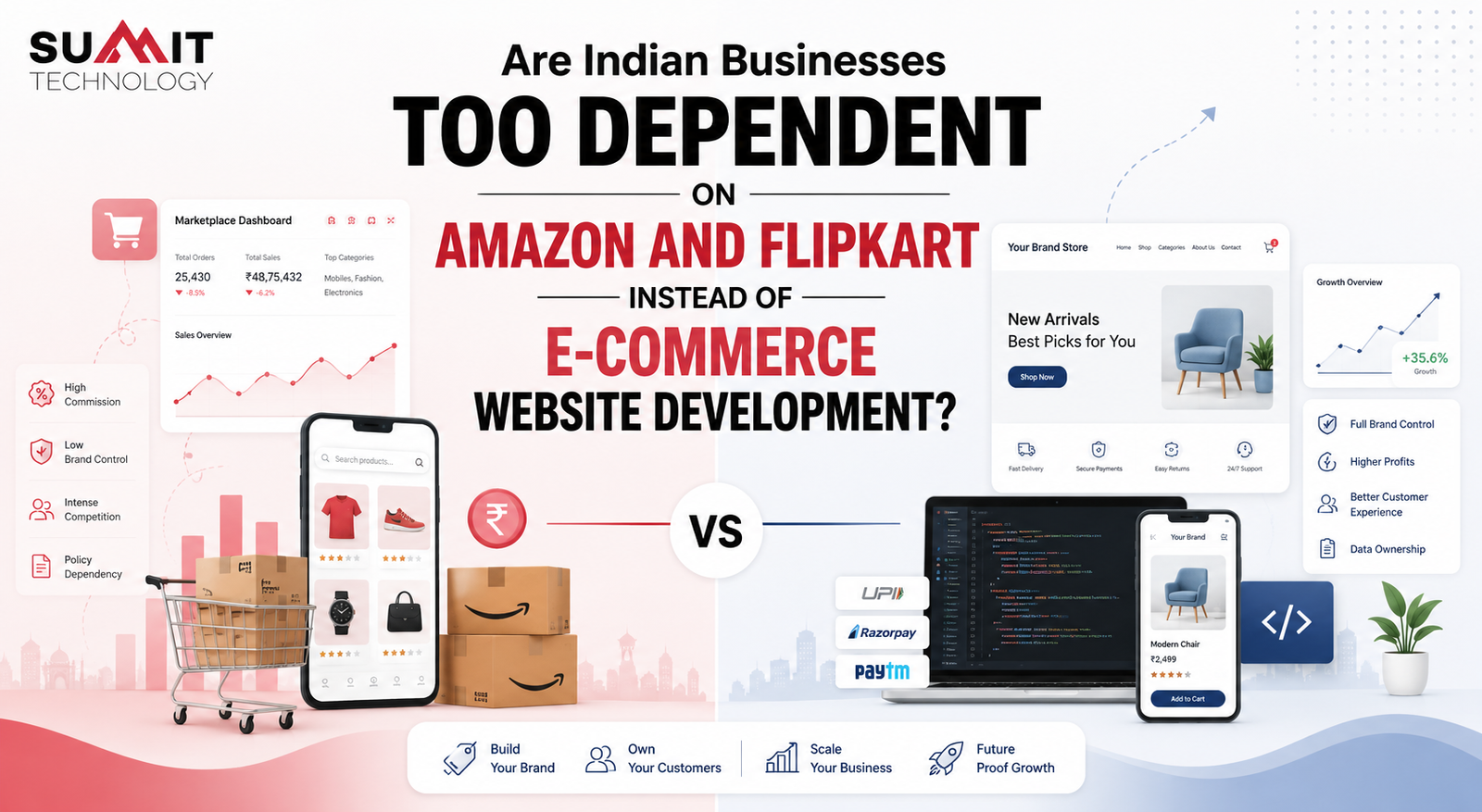
One of the major issues facing Indian sellers using these platforms is the massive commission structure, with a lack of ability to communicate their branding. Sellers can’t export their customer database, are not able to access the purchase frequency information, and do not have a direct connection with buyers who make transactions via the platform. Customers know Amazon. The customer doesn’t know about you.
It’s not an insignificant problem. This is a structural issue that prevents brand equity from developing over time, in the event that a business is entirely dependent on the marketplace, which is basically renting shelves in someone else’s retail store, and then hoping that customers will recall the item, rather than the store.
What Businesses Actually Lose Without Their Own E-commerce Website
The discussion about Custom E-commerce website development in India is typically framed in terms of an expense question. Owners of businesses ask, “How much will it cost?” but the most important issue is “How much am I losing by not having one?”
What operating only through third-party platforms steals away:
Relationships and customer data. Each purchase you make via Amazon or Flipkart can be traced back to the respective platform with regard to data. Companies are unable to retarget customers, create loyalty programs, or learn about the buying habits of customers. This data gap can translate directly into increased marketing expenses in the long run, since every customer acquisition experience is like the first experience.
Margin erosion due to commissions. Platform commissions usually range from 20-30% per order. Additionally, sellers are not able to negotiate regarding return policies. This will further reduce small margins. Custom E-commerce website development with a minimal upfront expense can be repaid through commission savings in an extremely short period of operation.
Differentiation of brands. When you look at any marketplace, it is possible to list a company with hundreds of rivals selling almost identical goods. Prices are the primary factor in determining a business’s worth. This”race to the bottom” is not a viable business plan but a gradual decline in value.
Dependency on algorithms. It is becoming apparent that the visibility of sellers on Amazon as well as Flipkart has become increasingly dependent on advertisements that are paid for on these platforms. Sellers who don’t invest in sponsored listings notice their natural visibility diminishing. It creates a repeating cost structure, with no lasting investments being made.
Why Custom E-commerce website development Changes the Picture
An e-commerce site that is well designed and developed is more than just a list page that has the payment gateway. It’s a flexible business platform. Businesses can create a narrative, establish trust, attract clients who return, and establish an unambiguous channel that is not affected by an algorithm or a change in policy that could suddenly alter.
Through an independent online store, companies do more than offer products but also establish a name, gain customers’ loyalty and keep all control of their revenues. In the long run, economics favours those who own their digital channels.
For Indian companies that target specific segments, niches or segments that are premium, the custom-built store gives you the potential to be a significant SEO. The product that is placed on Amazon increases Amazon’s authority on domains. An item on your site is a way to earn your own.
The Smarter Approach Is Not Marketplace vs. Website, It Is Both
The aim should not be to eliminate platforms such as Amazon or Flipkart immediately. They have a purpose for attracting new users and coordinating logistics on a large scale. They are not as important as the whole strategy.
Indian firms that are expanding effectively are utilizing marketplaces to discover their customers and also their own websites to retain customers. The traffic they drive via social media platforms as well as search engines to websites they control, in which the relationship between customers and their business grows in accordance with their specifications.
This is why partnering with the Best E-commerce website development company in India will make an enormous impact. A good development partner doesn’t just create an effective store, but they design one that’s quick, mobile-optimized, secure, and designed to maximize SEO right from day one.
Build What You Own Before Someone Else Owns Your Customers
The dependence of Amazon and Flipkart isn’t a weakness in ambition. This is an indication of the ease with which these platforms have made it into e-commerce. However, access isn’t equal to ownership.
Business owners who are committed to growth require a digital asset that compounds and builds the authority of a domain, data about customers, and brand recognition over time. Summit Technology works with Indian companies to create customized e-commerce sites that are built for actual efficiency, not only functional requirements. If the quality of your customer experience is important to your company, then it’s worthwhile starting the conversation today, prior to the time when the next market shift in policies makes it necessary.