Ask ten developers what technology you should build your business website on, and you’ll likely get ten confident, slightly conflicting answers. One will push a website builder because it’s fast. Another will insist on a JavaScript framework because it’s modern. A third will tell you PHP is the only sensible choice for a business site. Meanwhile, you’re the one who has to actually make the call, often without a technical background to evaluate any of these opinions properly.
Here’s the part nobody tells business owners early enough: the technology decision matters far less than most developers make it sound, and far more than most website builders want you to believe. The right answer isn’t about which language is the trendiest this year. It’s about matching the technology to what your business actually needs to do, now and over the next few years. Getting this decision wrong doesn’t usually show up immediately. It shows up eighteen months later, when you want to add a feature and discover the platform you chose simply can’t support it without a rebuild.
Why This Decision Feels So Confusing From the Outside
Part of the confusion comes from developers talking about technology the way car enthusiasts talk about engines, focused on specs and performance benchmarks that rarely matter to how your actual customers experience your site. A business owner doesn’t need to know whether a framework compiles faster in isolated tests. They need to know whether their website will load quickly, handle their product catalog, integrate with their payment processor, and still make sense to maintain three years from now.
The other source of confusion is that most comparisons online are written by developers, for developers. They’re useful if you already know the vocabulary. They’re nearly useless if you’re trying to make a business decision and keep running into terms like “server-side rendering” and “monolithic architecture” with no context for what that means for your bottom line.
Start With What Your Website Actually Needs to Do
Before any technology conversation makes sense, you need a clear answer to a more basic question: what is this website actually for? A five-page brochure site introducing your business is a fundamentally different project from an e-commerce platform processing hundreds of orders a day, which is different again from a portal where customers log in to manage their own accounts.
A simple way to think about it:
- A content-focused site (services, portfolio, blog, contact) generally needs a stable, well-supported platform more than cutting-edge technology.
- A transactional site (online store, booking system, payment processing) needs a backend that handles data, security, and integrations reliably under real load.
- A custom workflow site (client dashboards, internal tools exposed to customers, unique business logic) needs a technology flexible enough to be built around your specific process, not the other way around.
Most business owners jump straight to comparing technologies before they’ve actually answered this question, which is exactly why the decision feels so overwhelming.
Why PHP Still Powers the Majority of Business Websites
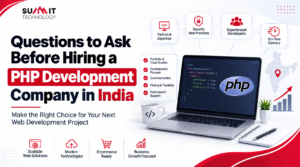
Here’s a fact that surprises a lot of people: PHP remains the backend language behind the overwhelming majority of websites with a known server-side language today, and that dominance isn’t a leftover from an earlier era of the internet. Modern PHP, particularly through the Laravel framework, has evolved considerably, with proper structure, strong security practices, and a mature ecosystem built specifically around real business needs like content management, e-commerce, and custom internal tools.
For most business websites, and especially for content-driven sites, service businesses, and mid-sized e-commerce platforms, Php web development services offer a genuinely practical advantage: a massive pool of experienced developers, extensive plugin and integration support, lower long-term maintenance costs, and a track record measured in decades rather than years. Newer frameworks often win headlines for raw performance in specific benchmarks, but for the vast majority of business websites, that performance difference is invisible to actual users, while the maintenance and hiring advantages of a mature ecosystem are very much visible to your budget.
This doesn’t mean PHP is the right answer for every project. A product built around real-time features, heavy AI integration, or a highly interactive single-page application may genuinely benefit from a different stack. But for the standard business website, brochure sites, service platforms, e-commerce stores, and client portals, PHP remains a proven, cost-effective foundation rather than an outdated one.
The Case for Custom Development Over Off-the-Shelf Builders
Website builders and templated platforms genuinely make sense for very simple, low-stakes projects. But the moment your business needs something specific, a unique checkout flow, an integration with your existing CRM, a booking system built around your exact process, templated platforms start working against you rather than for you. You end up designing your business process around the limitations of the tool instead of the other way around.
This is where custom website development India has become a genuinely strong option for businesses worldwide, not just locally. It combines experienced development talent with significantly lower project costs compared to hiring the same expertise in North America, Europe, or Australia, without necessarily compromising on code quality or long-term support, provided the development partner has a real track record to back it up.
A Simple Framework Before You Decide
Before committing to any technology or development partner, work through these questions:
- What does the website need to actually do in year one, not just look like?
- What will it likely need to do by year three, even if you’re not building that yet?
- Does this project need a unique, custom-built process, or would a proven, well-supported platform serve it just as well?
- Who will maintain this website after launch, and does that plan account for the technology’s long-term support and hiring availability?
- Is the proposed technology choice based on your business needs, or on what the development team happens to prefer working in?
That last question matters more than people expect. A good development partner should be recommending technology based on your project, not defaulting to whatever they’re most comfortable building in.
Making a Confident Decision, Not Just a Fast One
The technology behind your website should be invisible to your customers and dependable for your business, not a source of ongoing anxiety about whether you chose correctly. For most business websites, a well-structured, mature technology like PHP, combined with a development partner who takes the time to actually understand your business goals rather than pushing a default stack, delivers the most reliable long-term outcome.
Summit Technology works through exactly this kind of needs-first conversation before recommending any platform, because the right technology stack should come from what your business is trying to achieve, not from whichever framework happens to be trending. If you’re still deciding how to move forward, the most useful next step isn’t researching more frameworks. It’s having a direct conversation about what your website genuinely needs to do, and letting that conversation guide the technology choice from there.