An online store can have excellent products and still stay invisible in search. Often the cause is not a lack of effort but a lack of structure: hundreds of product pages with copied descriptions, category pages with no useful content, and filters that create thousands of near-duplicate URLs.
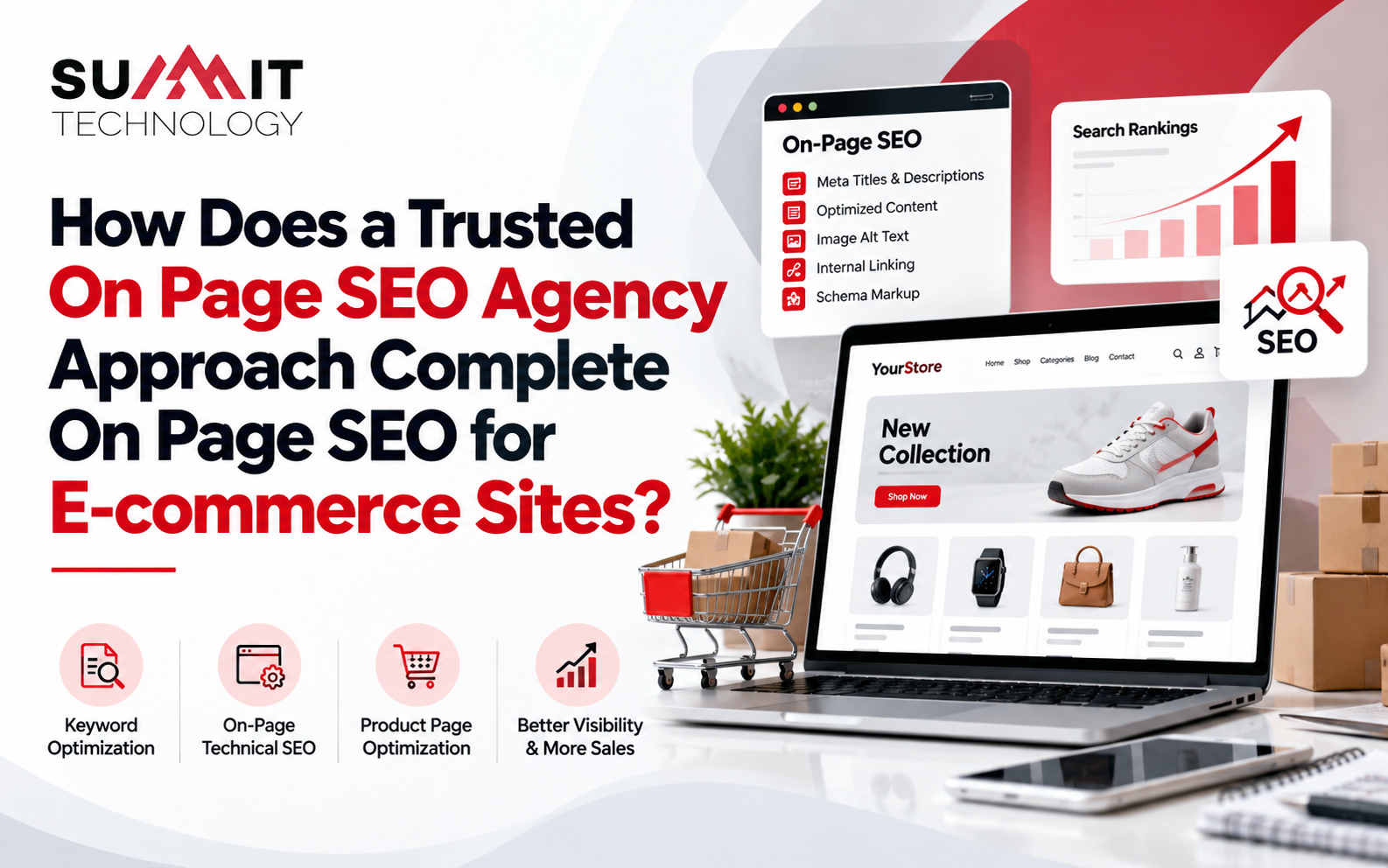
This is the problem a skilled on page SEO agency is hired to solve. Complete on page SEO for an ecommerce site goes far beyond editing title tags. It covers how each page is built, how pages connect, and how clearly each one tells search engines and shoppers what it offers. Here is how a trustworthy agency typically approaches the work, so you know what good looks like.
It Begins With an Audit, Not a Package!
A trustworthy agency starts with a thorough grasp of your store right now. In most cases this involves reviewing:
The pages that are indexed and not.
Duplicate or missing titles, headings, and descriptions
When products or categories only contain thin or copied content.For products and categories with thin or copied content.
The internal structure of the web page and the linking from one page to another.
This is a key factor in page speed and mobile experience.
Existing schema markup
The behavior of the filters, sorting, and paging.
From the audit comes a list in priority. Fixes that impact multiple pages are performed first, or the top pages that bring in the most revenue.
Mapping Keywords to the Right Page Types
A website built for ecommerce has unique page types, which should cater to different types of search.
Typically, category pages are used to attract queries that are broader in scope and are comparison-driven (such as a product type).
Product pages are optimized for specific, high-intent search queries like “model,” “size,” “material,” or “use”.
Blog and guide pages are created to answer information questions that direct shoppers to products.
Each page should have one main topic, not more than one, so that your pages are complementary, rather than competitive for traffic.
Rebuilding Category Pages
Often, the biggest opportunity is on the category pages where shoppers are still considering their choices. They’re usually enhanced by agencies by doing the following:
Creating a good introduction and writing a clear H1.
Including purchasing advice with answers to common questions
Connecting to important subcategories and collection connections
Maintaining the usability of the filters without producing crawl waste
Employing simple, descriptive URLs.
The aim is to create a page that enables a person to make a decision, not merely a matrix of products.
How to create pages that will earn their place.How to write product pages that will earn their place.
The best product pages are informative and persuasive:
Different description than what manufacturers copy!
This document provides specifications, sizing, materials, and compatibility in plain language.
Give images descriptive file names and alt text. Use descriptive image file names and alt text.
Shipping and returns, and availability information.
If they are honest customer reviews, they hold a great deal of significance.
Related product links to indicate the next step.
All of these are important for the user to have confidence in the page, and they all contribute to conversions as well as rankings.
The technical signals that belong in On Page Work.
Technical signals that belong in On Page Work.
For an ecommerce store, several technical factors fall under the umbrella of complete on page SEO:
Structured data: If you want the search engine to understand your page, you might want to use product schema, offer schema, review schema, or breadcrumb schema; all of these could lead to richer search results.
Canonical tags: If there are multiple URLs with the same content, the preferred one will be targeted.
Faceted navigation controls: Agencies can choose which filter pages they want to be indexed and which they don’t want to be.
Pagination handling: If the categories are large, there should be an obvious structure for pagination, enabling products to be found.
Out-of-stock and discontinued product rules: Redirects or clear messages create dead ends.
Page speed: Compressed images, lean code, and mobile-friendly layouts help to boost ranking and conversions.
Internal Linking and Site Architecture.
A reliable agency considers internal linking as a strategy. Breadcrumbs, similar product suggestions, and contextual links between guides and categories guide buyers and assist search engines in determining which pages are critical. It should be easy to find – not buried – the very important pages.
The process is generally followed in this way:
Audit and goals. Identify priorities according to traffic, revenue, and technical findings.
Keyword/PAGE mapping. Designate topics for each page type.
Templates first. Update templates for categories and products for improvements at scale.
Priority page optimization. Rewrite content and metadata of the best pages.
Technical clean-up. Tackle schema, canonicals, indexation, and speed.
Measurement and refinement. Monitor, optimize, and repeat for organic traffic to search, rankings, and sales.
How to Judge an Agency Before You Hire
Do they audit prior to proposing a scope?
Are they able to explain why they would choose to read in the order that they do?
Do they talk about the templates and scale, beyond talking about one at a time?
Not just rankings, will they report on revenue and conversions as well?
Are they wary of guarantees of rankings or quick results?
Common Errors to Steer Clear of
Thinking of on page SEO as a one-off thing. Catalogs, competitor, and search behavior changes.
Optimization of just a couple of best products. The rest of the catalog remains weak without templates.
Keyword stuffing in descriptions. It is poorly written and undermines trust.
Not respecting filters and duplicate URLs. They may consume crawl time and reduce signals.
Skipping measurement. If you don’t monitor, you’ll never know what is working.
The Takeaway
When it comes to on page optimization for an ecommerce website, it involves every page being optimized with a clear intent, with the page having a clear purpose, and linking the page to the rest of the website. That is exactly how a trusted on page SEO agency will work: Diagnose, Prioritize, Fix Templates, Refine with Data.
If you desire a hands-on walkthrough of your store’s pages, you can schedule a meeting with the folks at Summit Technology to discuss an on page plan that is based on your catalog, your priorities, and measurable goals.